Showing posts with label book review. Show all posts

Wednesday, February 8, 2012

Review: The Intuitionist (Colson Whitehead)


I am not completely certain that I understood everything Colson Whitehead had to say in The Intuitionist, his debut and critically acclaimed novel published back in 1998. I listened to Terry Gross interview Whitehead on her Fresh Air radio program when he released his latest novel, Zone One, about humans battling zombies in lower Manhattan. Not really my genre, but Whitehead sounded funny and smart and I suspected the book was not primarily about zombies. After the interview, I looked up an essay he had written on the sportsand pop culture blog Grantland about competing in the World Series of Poker in Las Vegas. The essay confirmed what the interview suggested, that Whitehead is complex, insightful, funny, evocative, all those things that good writers must be.

For Christmas, my in-laws gave me a copy of The Intuitionist. Engrossing, unexpected, complex, entertaining – yes, yes, yes, and yes. I finished this book a while ago and still wonder what it was about. On one level, it’s about intrigue within the elevator industry in what seems to be New York City in the late 1950s. Rival factions (the Empiricists and the upstart Intuitionists) battle for control of the city elevator inspectors’ union. The two major elevator manufactures have picked sides. All interests are racing to discover the mysterious invention of a recently deceased academic (and spiritual leader of the Intuitionist school), an invention that promises to revolutionize not only the elevator industry but the structure of the modern city. Thugs whose allegiances and motives remain ambiguous, have targeted a young elevator inspector named Lila Mae Watson, an Intuitionist who is second black inspector and the first black woman inspector in city history. 

On another level, The Intuitionist is an allegory about race and America. I think. Not completely sure. Nevertheless, the novel is smart with sufficient twists and detours to keep you engaged whether it’s about elevator wars or race relations. So if you stay up sipping Irish whiskey while reading this book late into the night, stop reading after the second glass or plan to do some rereading.  Lesson learned.  In the novel, alliances change and motives shift. Watson, tough, smart, quirky, and extremely competent, struggles to discover why she has been thrust into the conflict (the upcoming union election and search for the mysterious “black box”) while also discovering who, if anyone, she can trust. Intrigue ensures.

Whitehead has a unique and provocative voice.  I am anxious to work my way through more of his work. I’m even tempted to give the zombie novel a go.

RCM

Wednesday, January 4, 2012

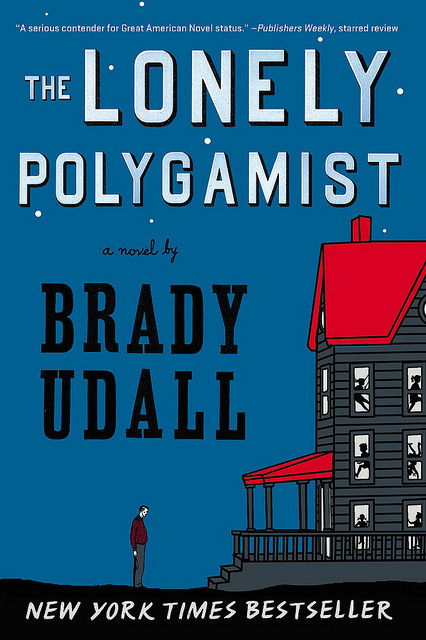
Review: The Lonely Polygamist (Udall)


Find time to read The Lonely Polygamist, Brady Udall’s poignant, bittersweet, and at times laugh-out-loud funny novel about 45-year-old Golden Richard’s mid-life crisis and its effects on his unconventional family.  Although the book is about a polygamist family, it is not really about polygamy.  Rather it's a study of family dynamics and relationships, functional and otherwise, that unfold within a family that features a husband, four wives, and 28 children dispersed among three separate households. Golden, the hapless patriarch, is an accidental polygamist. As a young man, he departed his native Louisiana for southern Utah to reunite with the father who had abandoned Golden and the boy's mentally unbalanced mother years earlier. After a childhood marked by isolation and loneliness, he finds his father's involvement in a fundamentalist break-away Mormon clan a revelation, with its focus on family and community. He soon begins his own polygamous journey and takes over his father's construction company as a way to meet the economic demands of his rapidly growing family.  He also learns to navigate a carefully choreographed schedule designed to satisfy the emotional and physical demands of each of his wives and the fatherly attention each of his children yearn for.

When we meet Golden, his construction business is slumping while the fiscal and emotional demands back home are escalating.  His only construction job is building an addition to a Nevada brothel, PussyCat Manor, while telling his family and community back in Utah that he's building a senior citizen’s center. He is depressed following the accidental death of one of his children, a profoundly disabled girl to whom he had become closely attached. And he is increasingly infatuated with a mysterious woman who he soon discovers is the Guatemalan wife of Ted Leo, the bellicose and volatile PussyCat Manor proprietor. Golden, increasingly overwhelmed by the daily details of his life, withdraws from his family, feigning impotency to avoid intimacy with his wives, finding excuses to stay in his trailer at the job site in Nevada, avoiding kids by hiding in their backyard playhouse or sleeping in his pickup. 

While the story is primarily Golden’s, Udall intersperses the perspective of two other members of the family. Rusty, the 11-year-old misfit son from wife number three, commits desperate and increasingly outrageous stunts in an effort to stand out from the crowd of siblings who detest Rusty nearly as much as he detests them. Trish, the youngest and most attractive of Golden’s wives, finds Golden’s lack of interest and competition with the other wives to be exhausting and defeating.  Like Golden, the neglected Rusty and Trish discover that life amid the clatter and din of a sprawling polygamist family can be exceedingly lonely.

Udall weaves the disparate strands of his story into a climax that is tragic and tender, with moments of levity from a colorful cast of characters recognizable to anyone who has spent time in the American west. The Lonely Polygamist does not end in a happy heap of sunshine and rainbows. We all walk away a little sadder but a little wiser. Udall has written a graceful page-turner with fresh characters and an attention to detail reflecting the author’s knowledge of his subject. As a bit of an aside, the Udall name may sound familiar.  The author is the descendent of a prominent family of early Mormon settlers (and practicing polygamists before the practices was prohibited by the Mormon church). He’s a cousin to current U.S. Senators Mark Udall (D-N.M.) and Tom Udall (D-Colo.).

The idea of reading a novel about a polygamist family that fails to castigate the practice may be unappealing to some readers. Like my wife, who is a hard sell on this topic, particularly after reading critical, non-fiction, accounts of contemporary polygamy, including Jon Krakauer’s excellent but chilling Under the Banner of Heaven, and Carolyn Jessop's Escape, an inside account of a woman coerced into a polygamous marriage and her attempts to escape with her eight children. Yes, there is a sinister side to polygamy and there are sects ruled by disturbing and corrupt men.  But Udall recognizes that not every polygamous community is headed by a Warren Jeffs.  Udall's polygamists feature a mostly assimilated community of semi-ordinary people living an unordinary lifestyle. The wives in Udall's novel may not be liberated feminists, but neither are they helpless victims. You can read Udall's explanation of why write a novel feature sympathetic polygamists here, if you’re interested.

A final note: I have not watched the HBO television serious, Big Love, which ran from 2006-2011, but know that it covers territory similar to The Lonely Polygamist, published in 2010.  The similarities are apparently coincidental. Udall says he hasn’t seen the HBO show and the genesis of his novel was a magazine article about a polygamist sect he wrote for Esquire magazine in 1998, titled "The Lonely Polygamist."  Trivia bonus: The original title he pitched to the magazine was "Big Love."


RCM