Wednesday, November 9, 2011

Review: Touched - The Jerry Sandusky Story (Sandusky 2001)

Years before Pennsylvania officials formerly charged him with allegedly being a creepy pervert, former Penn State University assistant football coach Jerry Sandusky wrote a biography! I noted this on Facebook the other day and pointed out that the biography’s title – Touched: The Jerry Sandusky Story – was a bit awkward, given that he had just been formally charged with molesting and raping numerous children, at least some of them in the Penn State locker room showers.
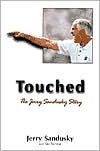
I received a lot of feedback suggesting this was a Book Monkeys review screaming to happen.  At least a review by the senior Book Monkeys representative (since the other one is 10).  OK, the feedback was from one of my brothers and a friend from law school, but probably a lot of other people were thinking this would be a great idea. Am I right? Hello?

Anyway, I had no interest in buying the book so I checked with my local library.  No luck.  The closest I could find was a country music CD by a local performer named Gary Sandusky.  Completely different guy.  So I turned to Amazon.com, which only had a leather-bound copy priced at $59.99, but even that was “temporarily out of stock.”  Stymied again.  Amazon.com’s “about the author” blurb, however, without a hint of intentional irony, noted that Sandusky is the founder of The Second Mile, “a charitable foundations that has touched the lives of more than 100,000 children.”  Yes. It actually said that. Sigh.

Also, my Amazon.com visit revealed that I was hardly the first to consider a post-scandal review of Touched.  In fact, Touched had been reviewed by 40 customers, and 39 of them had been submitted after the scandal broke less than a week ago, even through the book was published in 2001.  Our only pre-scandal “baseline” review occurred back in 2005.  At that time, “Stephen D. Bogner” (which may or may not be a pseudonym for “Jerry Sandusky”) absolutely loved Touched, awarding it five out of five stars:

When you finish this book you wish it was longer. Like a good movie you do not want it to end. It describes a man who has done some great things to help others. How many college football coaches would turn down 3 head coaching opportunities at big-time schools to stay in “Happy Valley”. A couple who could not have their own children. Then adopted 6. Not all in infancy. A man who took in foster children and at the same time ran the defense for one of college football's elite teams for 23 years. A kid who never grew up. Yet a person who is so selfless it defies human ego. Everyone reading this should do themselves a moral favor and contribute money to the Second Mile. (...).
  
Jerry Sandusky sure loves kids! In hindsight, Stephen might reconsider some of his phrasing, but I was too polite to track him down and bother him about it.  So that was our pre-scandal review.  Another reviewer, “bookfan” appears to have actually read the book before the scandal moved him/her to share:  

I actually read much of this book when it came out. At the time, I was disturbed by the egotistical and immature stories relayed in it. It would probably be great material to disect to learn more about how the mind of a pedophile works. 
 
OK, we’re off to a good start.  Interesting observation by our friend “bookfan.” Let’s see what we can glean from some of the other reviews surfacing in the days since the allegations against Sandusky became public. You’re up, “M.Munson”:

Mr. Sandusky is both a genius and a narcissist, which makes him the perfect predator. At no time was his narcissim more apparent than when he titled his book “Touched”. I guarantee this coward will “off” himself, before he ever spends a day with the general prison population. I, for one, would like to see him spend the rest of his life locked up with the general prison population; then, perhaps he can write the sequel entitled “Touched II: Predator Becomes Prey”. 

Harsh. But admit it, Touched II is funny, right?  Well, yes, predictable, but still. . . OK, moving along.  Maybe “dakota loomis” of Lawrence, Kansas, can illuminate us:

100% false advertising by Mr. Sandusky. Not a single page in this book “touches” on how to appropriately gain the trust of young, at-risk boys, and then use that trust to perpetrate horrifying sexual assaults on the very children who turned to you for guidance and support. Almost as disappointing as the first time I watched “Touched by an Angel.”Don't even get me started on that bullcrap. I still can't watch anything with Della Reese in it. 
 
Anyone else pissed at Della Reese? Well, don’t get “dakota loomis” started on that bullcrap. But, d-loom, enjoyed the snark (you were being ironic, right?). All right, let’s give  “79 Kaboom” a chance:

Based on the recent allegations against Jerry Sandusky, it appears that this book is in fact, a carefully crafted lie designed to present Coach Sandusky in a positive light. It should be sold as fiction because recent events have cast a shadow of doubt on everything presented in this book. And I agree with the other reviewer, the title of this book is offensive in light of the charges filed. Everyone who continues to buy this book is helping to pay for Sandusky's criminal defense. If Sandusky is convicted, Amazon should stop this book immediately. 


Ha! LOL! . . .”79 Kaboom” wants to label Touched as fiction while simultaneously banning its sale. Ha ha, I get it! What? This was one of the earnest, outraged reviews? My bad. In my defense, it sounded like satire.  And to be honest, I don’t think “79 Kaboom” read the book.   Do we have any legitimate “reviews” out there? Let’s hear from “lulumojo”:

Revolting, disgusting, evil, child abuse. Please remove this book, Amazon. How can you, in good conscience, have this book, with the unbelievably ironic title, still for sale? 

OK, “lulumojo” is right that Sandusky is accused of it dark, dark stuff.  But what about the book? Did you hate it? Did anybody read it? You’re our final contestant, “MMT”:

Disgraced OSU coaches Woody Hayes and Jim Tressel are grateful. Grateful the college football legend residing a few hours east of them will be more disgraced than either of them. Joe Pa turning a blind eye to child molestation easily trumps widespread illegal payouts or punching an opponent in the neck. 

You knew the Michigan fans would be all over this. Or is it really a Penn State fan attempting to shift some scandal to Ohio State? Or an Ohio State fan attempted to make sure Penn State head coach Joe Paterno is connected to this horror show? Big Ten politics are so confusing. And look! We’re off topic again. Seriously, has anyone other than “Stephen D. Bogner” and “bookfan” actually read this thing?

Well, I set out to review a book.  And like my fellow reviewers “79 Kaboom,” “dakota loomis,” “lulumojo” and others, I will do this one without the burden of actually reading the book.  So here, without actually reading the book, is the review I might have written had I not read it and reviewed in 2001, if you know what I mean:

Save yourself the trouble: Nobody wants to read Touched – The Jerry Sandusky Story – the biography of a middle-aged college football assistant coach.  There are literally thousands of current and former assistant college football coaches in America. Why do we need to read their life stories?  If any of them were really that damn interesting, they would be the head coach and they would have won a national championship or two.  Also, there’s something here I can’t quite put my finger on (get it? “finger on” and the book I’m reviewing is Touched?) and that is not quite right with Jerry Sandusky. Despite all the time he spends with vulnerable, at-risk boys, it sounds like he’s got some ulterior motive.  I just don’t get a positive vibe from Coach, as he likes the kids to call him, although from his account he does a lot of good for the boys, who really don’t have anyone else in their lives to confide in or trust.  The writing, by the way, is an unmitigated hackfest.  Could you possibly squeeze more clichés into a single book? I submit not.  I would definitely not recommend paying the $59.99 for the leather-bound edition.  Maybe pick up a copy of the paperback if you can find it at a used book store.  It might come in handy if down the road the author becomes infamous after committee some atrocity or another.

Looking back at my review, I’m struck by how prescient I was.  Further, I think my review of this book I haven’t read is far better than the other reviews of this book by people who have not read it.  Bottom line: You should all not read it and judge for yourself.

(RCM)


Tuesday, November 8, 2011

Book Snob Gets His Comeuppance


When it comes to literature, I can be something of a snob.  Not a sophisticated snob: I do not curl up in front of a crackling fire utterly lost in the delicate prose of an obscure 20th century French poet (Paul Claudel, perhaps) while softly humming Liszt’s Piano Sonata in B Minor between sips of a complex, nutty pinot noir.   But I am sufficiently pretentious to snub books that enjoy broad, popular appeal.  Maybe it’s my misanthropy showing, but if everybody likes something, how could it possibly be worthy of my consideration?

This smugness serves me well, except when the broadly popular book that everybody won’t shut up about happens to be awesome! This happened to me recently. Mostly to stop my wife’s relentless promotion of some silly book she had just finished, I agreed to give it a glance, flip through a few pages, see what the fuss was all about, and then tell her, politely, that it wasn’t something I found interesting.

So I flipped through a few page. Then a few pages more. Then I proceeded to invest a couple dozen hours over the next few days (hours that more reasonably should have been spent asleep) burning through a couple thousand pages of Swedish author Stieg Larsson’s enormously popular thriller/crime/mystery trilogy featuring Lisbeth Salander, the girl with a dragon tattoo (along with several other tattoos and some piercings).  Scary, crazy, violent, brilliant, profane, resilient, resourceful Lisbeth is also the girl who played with fire and the girl who kicked a hornet’s nest.  Along the way, she establishes herself as one of the most fascinating literary heroines since, well, ever.  She made me want to join the loose association of middle-aged and older men (Blomkvist, Palmgren, Armansky, Bublanski, Paolo Roberto, Anders Jonasson, et al.) who mobilize within the pages of the trilogy to protect her from the bad guys while convincing authorities that, contrary to appearances, Lisbeth is not a psychotic-mass-murdering-satanic-lesbian. Not that she encourages or appreciates her fan club, and she flatly rejects the notion that she needs protection from the bad guys.  It’s true: more often the bad guys need protection from Lisbeth.

The bad guys are perfect foils who dutifully receive their comeuppances: a serial killer/sadist/rapist, a Russian-hit-man-turned-Swedish-gangster, a renowned shrink with a dirty secret, an abusive guardian, a rogue Swedish secret police unit, a biker gang, and a giant human with a condition that prevents him from feeling pain.  Lisbeth disposes of several of the bad guys on her own, with a little help from a Taser, a nail gun, and a nasty attitude. Did I mention that she’s also junior high dropout and a world-class hacker with a photographic memory who solves unsolvable math problems in her head for fun?

Stieg Larsson died of a heart attack at age 50 not long after finishing his three best selling novels.  This trilogy (The Girl With the Dragon Tattoo, The Girl Who Played With Fire,The Girl Who Kicked the Hornet’s Nest) is not flawless.  The dialogue is clunky at times (maybe it’s the translation into English, or maybe that’s how Swede’s talk?).  Lisbeth has a twin sister, Camilla, who is mentioned but never appears, an annoying loose end. I kept waiting for her to appear suddenly, dramatically.  But no. Maybe Larsson was saving her for a later novel but died before writing it.  The biggest unexplained mystery, though, is why women in the trilogy relentlessly fling themselves at Mikael Blomkvist.  Certainly he’s interesting, but on paper he doesn’t come off as irresistible. He’s a slightly out-of-shape, self-absorbed, crusading journalist in his 50s who doesn’t even try to seduce the women who keep ending up in his bed.  Maybe Larsson (a slightly out-of-shape, middle-aged, crusading journalist) was projecting a bit.  But I don't judge. I will also be irresistible to women in the novels I write that feature a protagonist based on me. 

So I am chagrined and fully confess, while curled up by the fire with a moderately priced glass of Irish whiskey, a Merle Haggard tune (Big City) running through my mind, immersed in the adventures of my new crush, Lisbeth Salander, that popular doesn’t necessary equal insipid.  I admit that my beautiful and intelligent wife knew best.  This time. I love her but there's still no way I'm reading that Twilight crap.

RCM

Monday, October 24, 2011

Review: The Big Short (Lewis)

Driving home from work the other day, I sat in traffic while 300 of my fellow Boisians paraded through downtown on their way to the steps of the Idaho Statehouse.  The 300 were part of the Occupy Wall Street protest (in Idaho!).   Having just finished Michael Lewis’ The Big Short: Inside the Doomsday Machine (W.W. Norton, 2010). I was tempted to abandon my vehicle and join them. OK, not really. It was raining and I wanted to stop at the gym and then the liquor store and still get home in time for dinner.  And parking downtown is a bitch. But the thought really did cross my mind, thanks to Michael Lewis.


A while back I reviewed Too Big Too Fail (“TBTF”), Andrew Ross Sorkin’s revealing behind-the-scenes look at the scrambling in Washington and Wall Street to prevent financial collapse of Wall Street financial institutions in the wake of the October 2008 economic meltdown. I confessed to picking up Sorkin’s book at an airport bookstore mostly because it was already in paperback and thus cheaper than the book I really wanted, The Big Short.  I enjoyed TBTF.  It chronicles the immediate aftermath of the financial collapse and the stakes of bailing out some of Wall Street’s biggest players, who had arrogantly, recklessly over-leveraged themselves on subprime mortgage derivatives. But TBTF was more about the drama and less about the details of what precipitated the crash. And Sorkin failed to challenge his premise, that Wall Street was in fact too big to fail. Still, an informative read from an insider. 


The Big Short takes a step back and tells the story of the financial collapse from the perspective of a handful of outcasts who bet against (“shorted”) the subprime mortgage-backed bonds that were the root of the October 2008 financial collapse.  On one level, this book serves as a  Subprime Mortgage Disaster for Dummies: it explains in digestible fashion how we all helped create a housing boom through our collective exuberance even though any objective analysis should have revealed that it could not possibly last. Everyone accepted the fiction that the housing market would continue its phenomenal growth rate through infinity: the immigrant strawberry picker who took out the $750,000 mortgage for a California McMansion, the local broker who sold him the mortgage, the regional bank that approved it, the Wall Street investment bank that bought the mortgage and diced it up and dumped it into a bond with thousands of other high-risk subprime mortgages, the bond rating agencies that negligently underrated the risk of the subprime loan-backed bonds, the Wall Street traders who sold the bonds, and finally, the investors who bought these bonds.  Everyone bought into the fable.


Everyone, that is, except a few outliers who realized that the subprime mortgage bonds would hold their value only if home values continued to increase at the crazy pace of the mid-2000s.  And since that had never happened in the history of forever, they overcame their internal fears that they were crazy for bucking conventional wisdom and bet against the trend. They hit the jackpot when the housing boom went bust.  This is the core story of Lewis’ book and the core of what has become Lewis’ trademark in stories like Moneyball and The Blind Side.  He has a gift for explaining broad concepts through real life example.  The Big Short tells the story of a few individuals naive enough, or smart enough, and oblivious enough, or a combination of all of the above, who bucked conventional wisdom and risked betting against the trend.  The risk was that if they failed, they would be the (poorer) chumps. Lewis' book provides insight into those who were not afraid to fail while also providing insight into how the masses convinced themselves to defy reason.


Bottom line: if you are interested in making sense of how we found ourselves in the situation we are in today, The Big Short is a good place to start.

RCM

Saturday, August 13, 2011

Evolution of a Book Hog

I once was preoccupied with ensuring that books in my possession remained in my possession.  Hardcover classics, trashy paperbacks, biographies, historical monographs, inane fiction (I’m looking at you, Atlas Shrugged), outdated travelogues, law school case books.  Couldn’t  part with any of them.  Clung to my books as if their collective powers would pass to me and transform me by their proximity alone.  I rarely borrowed library books because my preference for book ownership defied economic logic.  I was not much into sharing, either.  I’d rather have loaned you a crisp twenty dollar bill than a coffee-stained paperback rescued from the discount bin at a seedy used book store. 

The attraction of book ownership, I suppose, was the solace that came from surrounding myself with all that knowledge and creativity, with knowing that all my favorite books were within my reach, waiting for me faithfully until such time as needed.  The exception being those books collected by my wife during her days in graduate school studying sociology. Sorry, Émile Durkheim and Max Weber, you just don’t do it for me.  Still, I liked having your gravitas readily available on my bookshelf. You know, just in case.

Lately, though, I’ve reconsidered my selfish ways.  Don’t know when it started, precisely.  But I would find myself in conversations with friends about books and hear a tiny inner voice urging me to pull a book from my shelf and send it home with my fellow reader. This book gets at exactly what we have been talking about, I would think to myself.  It would be great to share this with my friend! Of course, I quickly suppressed those heretical impulses.  A book from my shelf? Seriously? What if the unforgivable happened and it wasn't returned? I risked losing a friend and a book. But then one day, I followed my impulse and shared one of my books with a friend.

Guess what? Nothing bad happened. I didn’t miss the book at all. Nor did I miss the one I loaned to a different friend after that. Nor did I miss (too much) the one that never came back and the one that I no longer remember to whom it was loaned (I trust you are in good hands, Eats, Shoots, and Leaves: A Zero Tolerance Approach to Punctuation -- you will be remembered).  What I have learned from the experience is this: Remembering a book does not require the continued tangible availability of the book.  The greatness of a book is the ideas it conveys, not its physical presence.  And the truth is, a shared book can rekindle the initial joy of discovery each and every time it passes to a new reader.  Who knew that generosity could be so rewarding?  Open offer to anyone: if you're looking for something by Durkheim or Ayn Rand, hit me up.

RCM

Sunday, July 24, 2011

Review: God's Dogs (Wieland)

In God’s Dogs (SMU Press 2009), author Mitch Wieland’s protagonist, Ferrell Swan, examines his complicated relationship with himself, the ghost of his father, his ex-wife, and his adult stepson from the vantage of his self-imposed exile in a desolate, rugged corner of Idaho. 

Swan is a sixty-something from Ohio who checks out of his high school teaching job and third marriage and buys a piece of land as close to nowhere as he can find – the high desert and canyon lands of southern Idaho’s sprawling Owyhee County.  He builds a cabin and barn and buys a small flock of sheep.  The stories that comprise the novel were apparently written as stand-alone fiction; according to the cover God’s Dogs is a “novel in short stories.” I doubt I would have notice (or cared) if I had not been told, but in any event each “short story” is presented in chronological order featuring Swan as the protagonist and offering up a reappearing central cast of characters.  Swan’s periods of self-reflective solitude are disrupted by intrusive appearances by Swan’s vibrant, head-strong ex-wife, Rilla, his reckless adult stepson, Lavon, and a small band of neighboring misfits reckoning with their own fears and insecurities in the lonesome desert.  God’s Dogs, by the way, are the coyotes who frequent Swan’s desert and become a talisman for both Swan and Rilla.  

There’s plenty of brooding in God’s Dogs, but the novel is briskly paced.  Maybe because of the novel-in-short-stories framework.  Maybe in spite of it.  Don’t know.  Swan is a sympathetic protagonist: he seems to genuinely care that he has failed to give Rilla the emotional commitment she desires, and he’s sufficiently self-aware to recognize that his conduct is not unlike the emotional detachment his own flawed father had inflicted upon him.  Swan’s detachment extends to the charming but fragile Lavon, who plainly yearns for Swan to close the distance between the two.  But Lavon lacks the maturity to mend the relationship without help and Swan can’t muster the energy to shoulder the burden, a mutual failure that becomes the backdrop to Swan and Rilla’s greatest confrontation.

God’s Dogs relies heavily on sense of place: The Owyhee desert, complete with its coyotes and wild mustangs, is forever at the center of the novel, helping to shape and define the solace and loneliness in inhabitants find in its stark landscape.  The book is a satisfying journey through this physical landscape as well as the contours of Ferrell Swan’s complicated relationships.

RCM

Wednesday, June 29, 2011

Let Me Play!!!

Hey there!! I just wanted to let you know that some nerds (like me!) don’t just read Harry Potter and Percy Jackson, they read non-fiction too! I recently acquired a copy of Let Me Play - The Story of Title IX: The Law That Changed the Future of Girls in America, by Karen Blumenthal (2005, Simon & Schuster Children's Publishing Division).  I highly recommend it, as it is about the unfair treatment of girls and women across America before 1972 (the year Title IX passed), and how Title IX has helped girls across America take on jobs that had traditionally been reserved for men only. It also opened opportunities for girls to play in high school and college athletics. It was the main source for my PYP (Pick Your Passion), which was titled "How Title IX has Affected the Lives of Females Today." If you don’t feel like reading the book, or can’t find it, you should read my report, which includes a lot of information from the book. If you want to read it, email me at bookmonkeysblog@yahoo.com.

 SFM