Saturday, February 26, 2011

Review: Traffic: Why We Drive the Way We Do (and What It Says About Us) (Tom Vanderbilt)


Read this a while ago but still find myself telling people about it.  In fact, some of you are probably sick of listening to me talk about it, although I’m not one who allows something like that to curb my enthusiasm.  I am a big fan of writers who examine conventional wisdom and then challenge my long-held assumptions with their objective analysis (Freakonomics is one of my all-time favorite non-fiction reads).  Tom Vanderbilt hooked me with his prologue to Traffic: Why We Drive the Way We Do (and What It Says About Us), in which he makes a convincing case that the jerks who charge to the front of a merging lane and then force their way back into the traffic stream have it right when it comes to optimizing traffic efficiencies.  A particularly sobering chapter, “Why You’re Not as Good a Driver as You Think You Are” should be required reading for all of us. (Yes, even you).  Equally compelling is the chapter on “How Our Eyes and Minds Betrays Us on the Road.”  Consider that in our entirely evolutionary history, nothing has prepared us to travel at 80 mph while talking on a cell phone and yelling at kids in the backseat.  I was fascinated by a chapter that makes the case that better roads and more safety signs result in more and deadlier accidents than dangerous roads with limited signage (we drive slower and pay attention).  A favorite fact: one study demonstrated that drivers routinely failed to slow down when cautioned by a deer crossing sign, even when the researchers added flashing lights to the sign.  Drivers did slow down, however, when the researchers placed a deer carcass beneath the sign.

All along this wonderfully detailed journey of the way we drive, Vanderbilt avoids scolding readers for their ignorance and sloppy habits.  He frequently uses himself as the bad example and infuses his sometimes depressing news with humor and wit. If anyone wants to borrow my copy, I’m happy to share.  But please return it, because neither of my kids will be allowed behind a steering wheel until they’ve read it cover to cover.

RCM

Sunday, February 20, 2011

Friday, February 18, 2011

Review: Too Big To Fail: The Inside Story of How Wall Street and Washington Fought to Save the Financial System - and Themselves (Andrew Ross Sorkin)


This might be a first: a review that is both late (the book was published by Viking in 2009) and early (a HBO movie based on the book will be released in May).  But I finished the book several weeks ago and I offer this review while it remains relatively fresh in mind. I picked up my copy of Andrew Ross Sorkin’s Too Big To Fail (TBTF) at an airport bookstore after failing to bring enough reading material for my entire trip.  I was looking for Michael LewisThe Big Short  as part of an ongoing effort to wrap my head around the world of Wall Street finance. Not that understanding the basics of CDOs, credit default swaps, naked option writing, and assorted other obtuse financial instruments will help me save the world, but at least I’ll be able to follow along the next time it crashes.  Anyway, Lewis’ book was only available in hardcover and in these financial times, I passed on paying hardcover prices.  Sitting on the shelf next to The Big Short, however, was the paperback edition of TBTF.  I’m still looking forward to reading The Big Short (hint: someone has a birthday coming up), but TBTF did not disappoint.

Sorkin is a New York Times columnist and reporter who looks like he’s still in high school (he claims he’s 34).  The book, despite its bulk (the paperback version has 640 pages) was short on technical details about financial instruments and how they work, which was my primary motivation for picking it up.  Rather, TBTF is all about behind-the-scenes drama of the October 2008 implosion of Wall Street and how the Fed, Treasury, and a host of Wall Street characters struck (or in the case of some, failed to strike) deals that avoided complete failure of the Wall Street banking system.  Sorkin’s sources reveal an amazing story.  Greed, hubris, and incompetence are all on display.  Ben Bernanke, Henry Paulson, Timothy Geithner, Richard Fuld, Jamie Dimon, and Warren Buffet are among the primary characters.  (Bonus fact: in the HBO film, Paul Giamatti will play Bernanke and Ed Asner will be Warren Buffet).

While I wish Sorkin had provided more technical background to help wannabe financial nerds like me understand how Wall Street got itself into the mess it did, he more than adequately introduces us to the folks who screwed this up and those who stopped the collapse from becoming more widespread.  In the end, I was left wishing TBTF would have made the case for why all of this even mattered.  Sorkin seems to accept as an article of faith that saving Wall Street was necessary.  Yes, markets would have been disrupted and credit would dry up, at least temporarily.  But why would we not assume that some new system would emerge in its place?  I would have appreciated someone with Sorkin’s insight persuading me that bailing out the billionaires who screwed up the system was worth it. The bottom line, though, is that TBTF is a compelling drama and tells an important story that helps inform the broader picture of the present economic times.

RCM

Wednesday, February 16, 2011

Reading with Dad

After learning about the Lewis & Clark expedition and watching a video based on the book Undaunted Courage by Stephen Ambrose in class, I told my Dad about it. He proposed that we read Undaunted Courage and I accepted. When Dad and I read, we sit in an oversized leather chair by the fireplace and take turns reading the story. Past books we’ve read include To Kill A Mockingbird, by Harper Lee, The Call of the Wild and White Fang by Jack London, The Old Man and the Sea by Ernest Hemingway, Number the Stars by Lois Lowry, Moby Dick by Herman Melville and many more. In Undaunted Courage, I think that Stephen Ambrose does a good job of telling non-fiction in a story-like way. The book is mostly about Meriwether Lewis, and what I love is that is shows Lewis’s childhood, too, and not just what happened on the expedition. We’ve just started the book and I really enjoy it.  We’re already planning a camping trip to Lolo Pass, once of the places Lewis and Clark passed through in Idaho.

SFM

Sunday, February 13, 2011

A few of the toddler books we love

Living with a toddler who loves for us to read her books (repeatedly) inspired thoughts of a post about terrible toddler books.  Terrible in the sense that we cringe whenever the two-year-old thrusts one of these noxious volumes in our direction with an expectant look on her face. That post is coming, but so as not to appear to be cranky 100 percent of the time, I determined to deconstruct the genre to note the differences between good toddler books and, well, the less good. Up front you should know I’m looking at this from the perspective of the adult who reads the book to the toddler and my criteria may be highly subjective. I'm OK with that.  And yes, I agree that any book that holds a kids' interest has some redeeming qualities. But a good toddler book should share elements common to any good book: compelling plot, crisp writing, evocative language, suspense, interesting characters. And illustrations that allow pre-readers to follow the story while also causing pointing and delighted squealing.  After consulting with the toddler in the house, here are a few of our favorites (with author and illustrator):


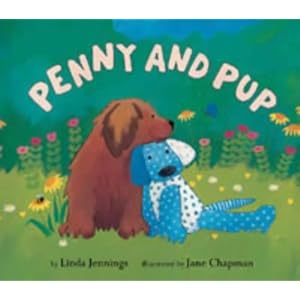
Penny and Pup/Linda Jennings & Jane Chapman. Both toddlers who are passing or have passed through this house have loved this book about Penny and her new stuffed friend, Pup.  When Pup becomes lost while exploring under a shed that smells of mice and old bones, Penny discovers a new group of non-stuffed friends.  Spoiler alert: before the story ends, Penny and her new friends actually find Pup.  Did not see that coming.

Hippos Go Berserk/Sandra Boynton. Short, snappy, and lots of fun.  All Ms. Boynton's books are favorites in our house.

Green Eggs and Ham, Dr. Seuss.  We are confused by the title: is it green eggs and green ham, or green eggs and regular ham?  But everybody in the house from toddler to nine-year-old to grumpy old parents love Dr. Seuss.  Green Eggs and Ham just happens to be the Seuss flavor of the moment.
  
The Potty Train/David Hochman.  It helped. Enough said.


We're Going on a Bear Hunt/Michael Rosen & Helen Oxenbury. It's catchy with lots of silly words that are fun for kids to say, i.e., "squelch squerch" as the intrepid family slogs through the oozy mud.  The family in the story also confronts a bear in its cave and then races for its life.  Spoiler alert: they survive. Barely.
Brown Bear, Brown Bear, What do You See?/Bill Martin Jr. & Eric Carle. A classic.  The book at our house is tattered at it appears that someone has chewed on one of the corners. 
Chicka Chicka ABC/Bill Martin Jr., John Archambault & Lois Ehlert.  A lively climb through the alphabet jungle with a grand finale.

RCM

Saturday, February 12, 2011

Big box book stores heading for the bargain shelf?

Digital movies helped speed Blockbuster's demise and digital books (with help from Amazon.com) are speeding the big box book store demise.  Borders is on a death watch. Obviously it should have adapted to change a lot better.  It will be interesting to watch how bricks-and-mortar booksellers adjust. It will be interesting to watch how readers adjust.   

RCM